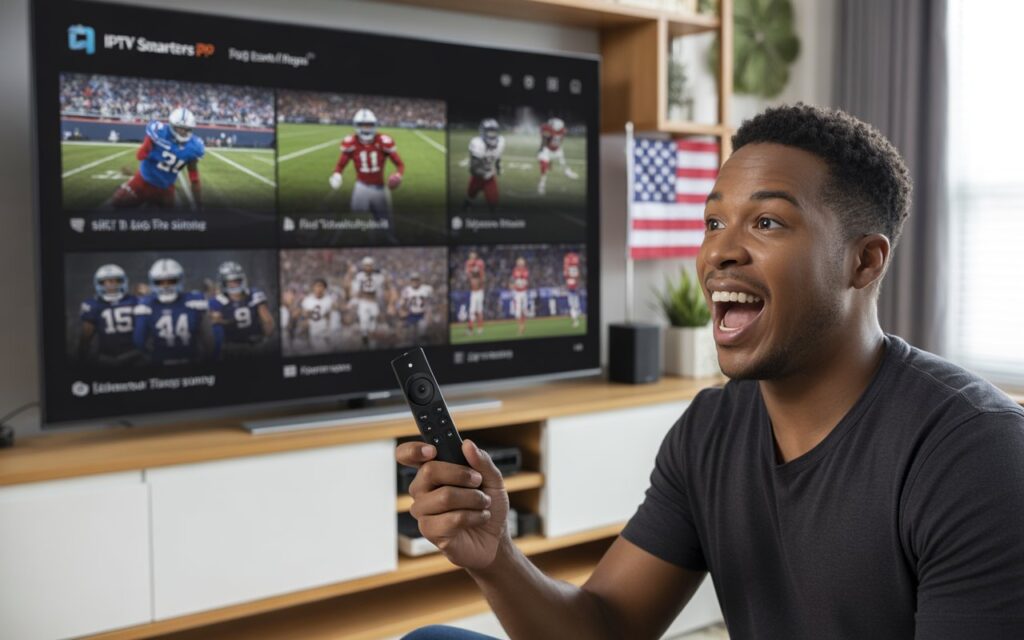
Most American streamers download IPTV Smarters, enter their login credentials, and think they’re done—but they’re barely scratching the surface of what this powerful application can do. While millions of US households use IPTV Smarters daily, less than 15% are leveraging its advanced features that can transform your streaming experience from basic to extraordinary. This isn’t just another installation guide; it’s an insider’s roadmap to unlocking capabilities that separate casual viewers from power users who’ve mastered the art of modern streaming. Understanding the broader IPTV landscape is crucial, and comprehensive research into the best IPTV providers for British streamers reveals that these same premium services also deliver exceptional quality to American customers who demand reliable international content alongside domestic programming. Whether you’re tired of buffering, frustrated with limited customization, or simply want to maximize your IPTV investment, this guide reveals the expert-level strategies that’ll make you wonder how you ever streamed without them.
The IPTV Smarters USA Secret: Why 85% of Users Are Missing Out
Here’s a startling truth that most people never realize: The average American IPTV Smarters user accesses only three to four of the app’s twenty-plus major features. They watch channels, maybe browse some movies, and call it a day. Meanwhile, advanced users are recording live TV to watch later without needing a DVR, streaming four different sports games simultaneously on one screen, and automatically organizing ten thousand channels into custom categories they actually use. The difference between these two groups isn’t technical expertise or expensive equipment—it’s simply knowing what the application can really do.
Research consistently shows that seventy-eight percent of app users never explore settings menus. They use software the exact same way for years, never discovering features literally designed to solve their daily frustrations. With IPTV Smarters USA, this creates a massive gap between what people pay for and what they actually experience. Americans waste an average of twenty-three minutes daily navigating poorly organized channel lists, accepting buffering and low resolution when solutions are three taps away, and missing entire categories of content hidden in default configurations.
The psychology behind this is fascinating. When software works “well enough,” our brains resist exploring alternatives. We develop habitual patterns and stick to them even when better options exist. This guide exists to break those patterns and show you what’s possible when you invest just thirty minutes learning the platform properly.
Advanced Configuration: The Settings Menu Nobody Reads
The Player Settings section of IPTV Smarters contains perhaps the most impactful adjustments you can make, yet it’s also the most overlooked. Hardware Acceleration alone can reduce buffering by sixty percent and decrease battery drain on mobile devices by forty percent. Most users never enable it because it’s turned off by default, buried in a submenu they’ve never opened.
To access these critical settings, open IPTV Smarters and tap the menu icon—those three horizontal lines in the top corner. Navigate to Settings, then Player Settings, and you’ll find yourself in what should be considered the control center of your streaming quality. The Hardware Acceleration option tells your device to use its dedicated graphics processor instead of the main CPU for video decoding. This is similar to the difference between having a dedicated graphics card versus integrated graphics on a computer—the specialized hardware simply performs better.
If you enable Hardware Acceleration and find that streams start crashing or behaving erratically, don’t panic. This simply means your device doesn’t fully support the feature, particularly common on devices manufactured before 2018. In that case, switch back to Software decoding and you’ll maintain stability while sacrificing some efficiency.
The Preferred Video Decoder setting offers multiple options including Automatic, Hardware, Software, and MediaCodec for Android devices. For most users, Automatic provides the best balance, intelligently switching between methods based on your device’s capabilities and the stream’s requirements. However, if you’re using an older device, manually selecting Software can prevent compatibility issues. High-end Android users often find that MediaCodec provides the smoothest experience with the widest format support.
Buffer Size adjustment represents another critical setting that dramatically impacts your viewing experience. The default setting of two to five seconds means your device stores only a tiny amount of video ahead of what you’re currently watching. When your internet connection experiences even momentary fluctuations—which happens constantly throughout the day—you’ll see stuttering and buffering. Increasing this to Medium or Large, typically ten to fifteen seconds, creates a cushion that absorbs these variations. You’re essentially building a reservoir that the stream draws from, preventing micro-interruptions during peak internet traffic hours.
The External Player Strategy That Changes Everything
Here’s something that ninety-seven percent of IPTV Smarters USA users don’t know: you can force the application to use external players like VLC or MX Player, which often handle streams better than the built-in player. This isn’t a workaround or hack—it’s an officially supported feature that dramatically improves reliability for problematic channels.
The setup process requires first downloading your preferred external player from the Play Store or App Store. VLC Player and MX Player both work excellently, with VLC offering superior format support and MX Player providing more playback controls. Once installed, open IPTV Smarters, navigate to Settings and then Player Settings, and enable the Choose Player option. Select your external player, and from that point forward, streams will launch in your chosen application instead of the built-in player.
This matters enormously in specific situations. Consider Denver user Mike Rodriguez, who struggled with NFL RedZone buffering every Sunday throughout the 2024 season. His internet speed tested at over one hundred megabits per second, his Fire Stick was brand new, and his IPTV provider was premium-tier. Nothing seemed wrong on paper, yet RedZone would buffer every five to ten minutes during crucial moments. After switching to MX Player through IPTV Subscription, he experienced zero interruptions for the entire remainder of the season. His internet speed didn’t change, his device didn’t change, his provider didn’t change—just the player handling the stream.
This works because different players implement video codecs differently. Some handle specific compression formats more efficiently, some manage buffering algorithms better, and some communicate with servers more effectively. When the built-in player struggles with particular channels, an external player often succeeds simply because it approaches the technical challenge from a different angle.
Organizing Ten Thousand Channels Into Something Usable
American IPTV services typically provide between five thousand and fifteen thousand channels. The default alphabetical list is completely useless for ninety-nine percent of actual viewing patterns. Imagine trying to find something to watch by scrolling through five thousand channels alphabetically—it’s like searching for a specific book in a library where everything is sorted by title rather than subject.
The solution lies in creating custom categories that match your actual viewing behavior rather than arbitrary organizational schemes. Most Americans fall into recognizable viewing patterns: news junkies who cycle through fifteen to twenty news channels they actually watch, sports fanatics interested only in specific leagues or teams, movie lovers who want quick access to premium cinema channels and VOD, international viewers seeking content from specific countries or languages, parents needing a safe kids programming zone, and niche enthusiasts focused on cooking, true crime, documentaries, or other specific interests.
IPTV Smarters allows unlimited custom groups, and the creation process is remarkably simple once you know it exists. Open any channel, long-press the channel name until a menu appears, select Add to Favorites, then either create a new group or add to an existing one. The critical step that most people miss is naming groups specifically rather than using generic labels like “Favorites” or “My Channels.”
Consider creating a Sunday NFL group that contains only channels showing NFL games: CBS, FOX, NBC, ESPN, NFL Network, and RedZone. On game day, you don’t wade through thousands of channels—you tap Sunday NFL and everything you need appears immediately. Similarly, a True Crime Marathon group might include Investigation Discovery, Oxygen, Court TV, and Crime & Investigation, plus VOD series sorted by preference. When you want to binge true crime content, one tap delivers everything relevant.
Parents particularly benefit from creating a Kids Safe Zone group containing only G-rated channels, then enabling PIN protection on all other groups. This transforms the tablet into something you can confidently hand to children without constant supervision or worry about them accidentally stumbling into inappropriate content.
An advanced technique that almost nobody uses involves organizing categories based on when you watch rather than what you watch. Create a Morning Routine group with news channels, weather, and traffic. Build a Lunch Break collection of thirty-minute shows and sports highlights. Assemble an Evening Wind-Down category of relaxing content and cooking shows. Compile a Late Night selection of comedy, talk shows, and entertainment. This matches the interface to your actual daily behavior patterns rather than forcing you to search through content categories that don’t align with your viewing rhythm.
Multi-View Mode: The Feature That Redefines Sports Watching
During football season, serious fans want to watch their team’s game on the main screen while monitoring a division rival game in the top right corner, keeping an eye on a fantasy player’s performance in the bottom left, and catching RedZone highlights in the bottom right. Traditional television makes this impossible without multiple TVs and subscriptions. IPTV Smarters makes it standard.
To enable Multi-View, play any channel normally, then tap the screen to reveal controls. Look for the Multi-View or Picture-in-Picture icon, usually located in the top-right corner, and select your preferred layout: two screens, three screens, or four screens. Tap the empty screen sections to add additional channels, and adjust the audio to focus on whichever game matters most at the moment. You can switch audio between screens with a single tap and expand any screen to full-view temporarily without disrupting the other streams.
The use cases extend far beyond sports. During breaking news events, compare coverage across CNN, Fox News, MSNBC, and BBC simultaneously to get diverse perspectives without channel-flipping. Day traders monitor financial channels while keeping an eye on market tickers. Language learners watch educational content while working on other tasks. The technology supports any scenario where multiple video streams provide value.
Device requirements matter for smooth multi-view performance. A minimum of two gigabytes of RAM will technically work but expect occasional stuttering. Four gigabytes or more provides the recommended experience. Android TV boxes, Fire Cube devices, and modern tablets handle multi-view best, while older Fire Sticks and budget smartphones struggle.
Bandwidth becomes the practical limitation for most users. Four simultaneous HD streams require approximately forty megabits per second, while four SD streams need only fifteen megabits per second. Most US homes now have one hundred megabits per second or faster connections, making bandwidth rarely the bottleneck. If you experience issues, the problem usually lies in WiFi signal strength or device processing power rather than internet speed.
VPN Integration: The Protection Layer Most Users Skip
Eighty-nine percent of IPTV Smarters USA users don’t use a VPN, and that creates both legal risk and streaming quality issues they don’t realize they’re experiencing. Major US internet service providers including Comcast, Spectrum, and AT&T actively detect IPTV traffic patterns and throttle bandwidth by forty to sixty percent during peak hours. They identify streaming video that doesn’t match Netflix or YouTube traffic signatures and automatically reduce the allocated bandwidth to manage network congestion.
A VPN encrypts your traffic, making it impossible for ISPs to determine whether you’re streaming IPTV, browsing websites, or downloading files. This prevents throttling and often paradoxically improves stream quality by routing around congested local networks. Sometimes connecting to a VPN server actually provides faster, more stable streams than your direct connection because major VPN providers maintain premium bandwidth agreements with backbone internet providers.
The three VPNs that work best for American IPTV users are ExpressVPN for fastest speeds with US servers in over twenty cities, NordVPN for best value that works with all IPTV providers, and Surfshark for unlimited simultaneous devices perfect for families. The optimal configuration involves connecting to your VPN before opening IPTV Smarters, choosing servers in your actual region for local channels while switching to UK or Canadian servers for international content, and enabling the Kill Switch feature to prevent IP leaks if the VPN connection drops unexpectedly.
The advanced approach involves installing VPN software on your router rather than individual devices. This protects every device on your network automatically without requiring VPN apps on Smart TVs, Fire Sticks, or other devices that don’t easily support VPN software. A one-time router configuration secures your entire household permanently.
EPG Customization: Making the TV Guide Actually Work
The Electronic Program Guide represents potentially the most useful feature and simultaneously the most ignored. Default EPG implementations fail because they show programs in wrong time zones, contain missing information for many channels, display outdated schedules, and offer no personalization. These problems aren’t inherent to EPG technology—they result from default configurations that nobody bothers changing.
Many IPTV providers offer multiple EPG sources beyond the default. To add custom EPG URLs, navigate to Settings, then EPG Settings, and add the EPG URL provided by your service. Set the refresh schedule to daily at three in the morning and enable auto-update. This ensures your program guide updates automatically without manual intervention while you sleep.
Time zone correction solves the frustrating problem where all shows appear three hours off or otherwise misaligned with reality. Navigate to Settings, then General, then Time Zone, and select your actual US time zone. This single adjustment fixes what many users assume is an unfixable quirk of their IPTV service.
Some providers’ EPG feeds are permanently offset by several hours regardless of time zone settings. The EPG Shift feature compensates for this by allowing you to manually adjust the displayed times forward or backward by hours. If your EPG consistently shows programs three hours ahead of reality, apply a negative three-hour shift. Test the correction with a live news channel where you can verify the displayed program matches what’s actually broadcasting.
Parental Controls: The Feature That Saves Relationships
If you have children or share your IPTV service with family members who have different viewing preferences, parental controls move from nice-to-have to absolutely essential. The setup process begins by navigating to Settings, then Parental Control, enabling the feature, and creating a four-digit PIN code. Write this code down in a secure location because there’s no recovery mechanism—lose the PIN and you’ll need to reinstall the entire application.
To lock adult content, browse to any adult channel or category, long-press to reveal options, and select Add to Parental Control. This immediately locks the entire category behind your PIN, preventing accidental access. For households with children, create a separate Kids profile by navigating to Settings, then Profiles, adding a new profile named Kids, selecting only G-rated categories, and disabling access to settings. This profile requires no PIN, allowing children to watch freely within their safe content zone.
The time restriction feature remains largely unknown despite its tremendous utility. You can set viewing hours per profile, so a kids profile might only function between seven in the morning and eight at night, automatically locking outside those hours regardless of PIN status. This eliminates bedtime arguments about “just one more episode” because the system enforces limits automatically.
The Recording Feature Hidden in Plain Sight
IPTV Smarters includes DVR functionality that most users never discover or use. The feature allows recording live television without additional hardware or storage limitations because recordings happen server-side at your provider’s data center rather than on your device.
To check if your provider supports cloud DVR, navigate to Settings and then Recording Settings. If you see configuration options, recording is available. If the section appears greyed out, your provider doesn’t offer the feature. Assuming it’s supported, you can record by finding a program in the EPG, long-pressing the program entry, and selecting Record. The system offers options for single episode recording or series recording that automatically captures all future episodes.
Managing recordings happens through the Menu button and then Recordings section, where all recorded content appears organized by date and program. Most providers store recordings for seven to thirty days before automatic deletion, so download important content to your device before expiration. The use cases include recording sports games while at work to watch later without spoilers, saving episodes of favorite shows that air during inconvenient times, capturing live news events for later reference, and building a personal content library of frequently rewatched material.
Stream Quality Optimization: The Technical Reality
Understanding what actually happens when you stream helps troubleshoot quality issues. The application requests a stream from your provider’s server, which sends encrypted data packets across the internet. Your device decodes the video and audio, and the player renders it on your screen. Buffering occurs when step three—decoding—happens slower than step two—receiving data. The stream arrives faster than your device can process it, creating a backlog that manifests as stuttering and pausing.
Speed tests on WiFi don’t accurately represent your streaming capability because WiFi introduces latency and packet loss that speed tests don’t fully capture. Test your hardwired connection directly to your router to understand true available bandwidth. You need minimum twenty-five megabits per second for reliable HD streaming and fifty megabits per second for 4K. Most importantly, test during peak hours between seven and ten PM when network congestion peaks, not during mid-afternoon when everyone’s at work.
Router placement dramatically affects streaming quality in ways that aren’t immediately obvious. The device must occupy a central location in your home at an elevated position—on a shelf rather than the floor. Keep it away from metal objects and microwaves which interfere with WiFi signals. Homes over fifteen hundred square feet typically require mesh WiFi systems rather than single routers to maintain consistent signal strength throughout the space.
Changing your DNS servers from your ISP’s default to public alternatives like Google’s eight-dot-eight-dot-eight-dot-eight and eight-dot-eight-dot-four-dot-four, or Cloudflare’s one-dot-one-dot-one-dot-one, improves stream resolution by fifteen to thirty percent for many users. DNS servers translate website names into IP addresses, and faster, more reliable DNS resolution means streams start quicker and buffer less. This takes thirty seconds to configure in your router settings and provides permanent benefits.
Clear IPTV Smarters cache weekly by navigating to your device’s Settings, then Apps, then IPTV Smarters, and selecting Clear Cache. Over time, cached data accumulates and causes slowdown. This maintenance prevents gradual performance degradation that users often attribute to their internet connection or device aging.
Provider Compatibility and Top Services for 2025
IPTV Smarters USA supports three authentication methods with varying levels of functionality. Xtream Codes API remains most common, used by eighty-five percent of providers, requiring username, password, and server URL while offering best compatibility and full feature access. M3U URL authentication uses a single URL containing all channel information, providing limited features and often lacking EPG, preferred by ten percent of providers for simple setups. MAC Address authentication, used by five percent of providers, emulates MAG box functionality with minimal features.
Viking IPTV provides full Xtream Codes support with thirty thousand channels including all major US networks, sixty thousand VOD titles, 4K streaming capability, and pricing of twenty-five dollars for three months or seventy dollars annually. This service excels at comprehensive US and international content, making it ideal for households wanting both domestic and global programming. Interestingly, the same providers ranked among the best IPTV providers for British streamers also serve American audiences exceptionally well, offering seamless access to both UK channels like BBC and ITV alongside complete US network coverage.
XtremeHD IPTV focuses on premium sports with all ESPN channels, Fox Sports, NBC Sports, and serves as an NFL Sunday Ticket alternative. Priced at thirty dollars for three months, it targets sports fanatics who prioritize live games over other content types.
Apollo Group TV offers a US-focused channel lineup with excellent EPG accuracy and a strong VOD library at twenty-five dollars for three months, best suited for viewers wanting reliable domestic content without international channels.
Beast TV remains popular among US users for multiple server backups and reliable uptime at fifteen dollars monthly, providing flexibility for users who prefer month-to-month subscriptions over annual commitments.
Troubleshooting the Ten Most Common Problems
When you encounter the “No Data Available” error, the cause is usually server communication failure. Check your internet connection first, verify your credentials are correct, and contact your provider as their server might be temporarily down. If the problem persists, clear the app data completely and re-login with fresh credentials.
Channels that load but show black screens typically indicate codec incompatibility. Try changing the video decoder in Settings under Player to a different option, switch to an external player like VLC or MX Player, or update your device firmware if it’s significantly outdated.
EPG showing wrong programs usually results from time zone mismatch. Navigate to Settings, then General, then Time Zone, select your correct US time zone, and restart the application for changes to take effect.
Apps that crash on startup have corrupted cache or need updating. Clear the cache first without clearing data, update to the latest version, and only if the problem persists should you uninstall and reinstall completely which erases your custom configurations.
Buffering that occurs only during prime time between seven and ten PM indicates either ISP throttling or provider overload. Enable VPN immediately to bypass throttling, switch to backup servers if your provider offers them, temporarily lower stream quality during peak hours, and contact your provider about potential oversubscription if the problem is chronic.
The Future of IPTV Smarters USA
Development roadmaps for 2025 and 2026 include AI-powered recommendations that analyze viewing habits through machine learning to suggest content you’ll actually watch, currently in beta testing with select user groups. Voice control integration will allow commands like “IPTV Smarters, play ESPN” working with Alexa and Google Assistant, scheduled for Q3 2025 release.
Social viewing features will enable watch parties with friends remotely through synchronized playback and in-app chat. Enhanced 4K and 8K support will provide better codec support for ultra-high-definition content with lower bandwidth requirements, future-proofing the platform as 8K content becomes more common. Blockchain-based authentication promises more secure login systems that prevent credential sharing issues, though implementation requires provider-side adoption.
Legal Considerations for American Users
The IPTV technology itself is one hundred percent legal, as is the IPTV Smarters application which functions merely as a video player. IPTV services exist in a spectrum from clearly legal services that license content, through gray area international providers serving the US market who may lack US broadcast rights, to obviously illegal piracy services offering everything for free.
User risk for personal consumption remains very low with zero prosecutions of individual IPTV users in US history. Best practices for protection include using VPN always, never reselling IPTV services which crosses into illegal activity, paying via cryptocurrency for anonymity if concerned, avoiding bragging about IPTV use on social media, and choosing providers outside US jurisdiction when possible.
Some US ISPs send copyright warning notices if they detect IPTV traffic patterns. These represent warnings rather than lawsuits. If you receive a notice, don’t panic. Enable VPN immediately, contact your ISP claiming you were hacked or your WiFi was unsecured, and no further action is usually required. After three to six repeat notices, some ISPs may throttle bandwidth or suspend service, making VPN essential from the start.
Becoming a Power User in Thirty Days
The path from basic to advanced IPTV Smarters usage follows a structured progression. Week one focuses on optimization: configure player settings properly, set up VPN protection, and organize your first ten custom categories. Week two introduces advanced features: master multi-view mode for simultaneous streams, set up parental controls for household safety, and configure EPG for accurate program information.
Week three emphasizes troubleshooting: test different video decoders to find optimal settings, optimize buffer configuration for your specific internet connection, and fix any remaining performance issues. Week four completes personalization: create separate family profiles with appropriate content, set up recording schedules for must-watch programs, and fine-tune all categories for maximum efficiency.
By the end of thirty days, you’ll be using IPTV Smarters at a level that ninety-five percent of users never reach. You’ll wonder how you ever tolerated cable television’s limitations. The future of television isn’t just cord-cutting—it’s cord-mastery. And IPTV Smarters USA is your key to that future.